


Dotted-line reporting can increase cross-functional coordination, but it also creates ambiguity around authority, priorities, and accountability. That makes it an organizational design choice, not just a management preference. To work well, dotted-line relationships need clear decision rights, defined performance ownership, and visible reporting structures.
What Is Dotted Line Reporting?
Dotted-line reporting is used when organizations need cross-functional coordination without shifting full management authority. It can support collaboration across teams, regions, or specialized functions, but it also requires clear boundaries around decision-making, accountability, and performance ownership.
Table of contents
- What Is Dotted Line Reporting?
- When Dotted Line Reporting Works and When It Doesn’t
- How Dotted Line Relationships Work in Practice
- Decision Rights and Performance Accountability
- Managing the Most Common Challenges
- Dotted Line Reporting and Indirect Reports
- How Dotted-Line Relationships Are Represented in Org Charts
- Governance and Clarity at Scale
- When to Reevaluate or Redesign Dotted Line Relationships
- Learn More About Reporting Lines and Organizational Structure
What Does Dotted Line Reporting Mean?
Dotted-line reporting is a reporting structure in which an employee has a primary manager and a secondary reporting relationship to another leader, team, or function. That secondary relationship typically supports cross-functional coordination rather than full managerial control. Dotted-line reporting can improve collaboration and visibility across teams, but it works best when authority, decision rights, and accountability are clearly defined.
Dotted Line vs Solid Line Reporting
Solid-line and dotted-line reporting represent different types of reporting relationships. A solid line connects an employee to their primary manager, who typically owns formal authority, performance evaluation, and priority-setting. A dotted line shows a secondary relationship that usually provides input, coordination, or functional guidance, often across teams or business units.
The main differentiators between dotted and solid line relationships include:
- Authority: In a dotted-line relationship, the secondary manager usually has limited or context-specific authority. In a solid-line relationship, the primary manager typically holds formal management authority.
- Accountability: In dotted-line structures, employees may be accountable to more than one stakeholder for specific deliverables, but accountability should still be clearly defined. In solid-line structures, accountability is usually centered on the primary manager relationship.
- Performance Ownership: In many dotted-line structures, the primary manager leads the formal review process, while the dotted-line manager contributes structured input. In solid-line structures, performance ownership usually sits with the primary manager.
- Priority-Setting and Decision-Making: Dotted-line structures often require more alignment across managers, which can slow decisions when roles are unclear. Solid-line structures usually support faster prioritization because decision authority is more centralized.
Here’s a quick chart to break this down further:
| Solid-Line Reporting | Dotted-Line Reporting | |
| Authority | Primary, formal authority | Limited, contextual authority |
| Performance ownership | Owns the formal evaluation | Provides structured input |
| Priority-setting | Final decision-maker | Advisory / negotiated |
| Typical use | Functional ownership | Cross-functional coordination |
| Risk if unclear | Bottlenecks | Conflicting priorities |
When Dotted Line Reporting Works and When It Doesn’t
Dotted line reporting is best used in situations where collaboration across departments or disciplines is crucial. However, this structure must be implemented strategically to avoid communication roadblocks and recurring conflicts within the chain of command.
Common Use Cases
There are three main instances where dotted line structures are extremely beneficial to teams. This includes:
- Cross-Functional Projects: Dotted line structures can be used to leverage resources and specialized skillsets across departments, allowing all teams to boost efficiency, effectiveness, and goal attainment while collaborating.
- Shared Services and Centers of Excellence: When your organization’s work relies on various inputs from highly-specialized experts, dotted line relationships ensure everyone’s recommendations are accounted for and can be implemented properly.
- Global or Regional Alignment: Working across countries, regions, and time zones can lead to communication breakdowns, but dotted line reporting builds a better web of support for dispersed teams. This way, there are multiple points of contact who can provide input during times of conflict or confusion.
When Not to Use Dotted Lines
While dotted line relationships can be incredibly effective in certain projects, they’re highly specific structures that easily cause issues when leveraged inappropriately. Revert to solid lines when dealing with any of the following situations:
- Crisis Response Environments: When time is of the essence, you can’t risk going down multiple communication paths for every small decision. Dotted lines create information gaps and slow down decision-making in the best of circumstances, never mind crises. Solid lines streamline communication and allow employees to take action fast.
- Rapid Centralized Authority: As organizations grow, you may implement top-level, high-impact roles that can’t waste time waiting for multiple inputs. Solid lines allow people to act quickly in well-defined roles, preventing ripple-effect bottlenecks.
Persistent Overload: With multiple managers, you run the risk of leaving employees with conflicting instructions and misaligned priorities, creating confusion, burnout, and subpar results. Solid lines eliminate overload and help give employees purpose.
How Dotted Line Relationships Work in Practice
Dotted-line reporting only works when the workforce is supported by clear authority boundaries, defined accountability, and documented reporting relationships.
Dual Accountability and Shared Authority
Within dotted line relationships, employees and managers must contend with dual accountability and shared authority, which can lead to conflicts. In these relationships, employees remain accountable to multiple managers for their performance and project outcomes, but these managers do not have equal authority over their day-to-day workload. The primary manager will direct the employee’s daily responsibilities and retain authority over their priorities, and the secondary manager will only influence the tasks that are housed in their department, division, or team.
In dotted-line structures, clarity has to come from the design itself. Organizational planning, decision ownership, reporting boundaries, and escalation paths should be documented so the relationship reflects shared coordination without creating equal authority.
The Dotted Line Manager’s Role (and Limits)
As a dotted line manager, you take a secondary seat to an employee’s success. This role is focused on influence rather than formal authority. Dotted line managers cannot assume full control over an employee’s projects, collaborative relationships, or day-to-day success.
Dotted-line relationships work best when manager-to-manager alignment is built into the structure and conflicts are resolved through defined governance channels.
Trusted by 2,000+ companies worldwide




























Decision Rights and Performance Accountability
Managing multiple reporting relationships is a balancing act for both employees and authority figures. Establishing clear decision rights and performance accountability can simplify these connections.
Who Owns Priorities When Managers Disagree?
When a solid-line and dotted-line manager disagree, the primary manager often has final authority, unless decision rights have been assigned differently.
As they maintain control of the employee’s workload and performance, their input takes precedence during times of conflict. Aligning on project priorities, time spent, and expectations at the start of a project helps prevent conflicts and avoid burning out the shared employee.
Employees should not be expected to resolve disagreements between managers. When that happens, it usually indicates a governance failure: decision rights, escalation ownership, or reporting boundaries have not been defined clearly enough.
Who Owns Performance Evaluation?
In many dotted-line structures, the solid-line manager owns the formal performance review process. The dotted-line manager may still provide structured input so cross-functional work is reflected in the evaluation.
However, the dotted line manager should provide structured input ahead of time, whether through a mediated conversation with the primary manager or in a survey sent through HR. By getting the secondary manager’s input, HR can ensure all of the employee’s work is properly credited, and none of their cross-functional contributions are lost in the shuffle. This helps reduce the risk that cross-functional contributions become overlooked and gives the review a more complete view of performance.
The dotted line manager’s performance input should cover:
- Outcomes delivered
- Collaboration quality
- Work quality
- Reliability and consistency
- Stakeholder impact
- Team impact
Here’s a short chart with a breakdown:
| Decision Authority | Performance Accountability | Escalation Path | |
| Solid-line manager | Final authority | Full ownership | Functional leadership |
| Dotted-line manager | Input and guidance | Contributing input | Solid-line manager |
| Employee | Executes decisions | Delivery accountability | Both managers (not a mediator) |
Managing the Most Common Challenges
While it can be a very effective way to manage an organization, dotted line reporting does not come without its challenges.
Conflicting Priorities and Misalignment
Conflicting priorities usually indicate that decision rights or escalation ownership are not clearly defined. When both managers can direct work without a shared view of authority, employees can be pulled in competing directions and delivery can stall. In well-governed dotted-line structures, disagreements are resolved through defined reporting boundaries and escalation paths rather than informal negotiation through the employee.
Role Ambiguity and Employee Confusion
Role ambiguity usually reflects a documentation or organizational design gap rather than an individual communication issue. It becomes more likely when reporting relationships, decision ownership, and priority-setting authority are not clearly defined.
Workload and Capacity Conflicts
Workload conflicts become more likely when multiple managers can assign work without a shared view of priorities, bandwidth, or delivery ownership. This is a structural risk that requires clear accountability, capacity visibility, and coordination across reporting lines.
Dotted Line Reporting and Indirect Reports
Dotted line reporting structures often come with indirect reports, further complicating relationships and creating potential for conflict. These connections must be properly managed to avoid issues at multiple organizational levels.
How Indirect Authority Appears in Dotted Line Setups
Indirect reports are relationships between an employee and their manager’s manager. Within a dotted line structure, this can add a layer of complexity when secondary indirect reports have influence over an employee’s workload. Here, indirect authority is typically used in an oversight capacity, allowing a secondary indirect report to monitor how an employee is impacting the team and how their projects have contributed to departmental success.
How Dotted-Line Relationships Are Represented in Org Charts
Organizational charts are used to represent the different reporting relationships and teams within an organization. Dotted lines must be included in the chart to give employees a full understanding of their company’s structure.
What a Dotted Line Means in an Org Chart
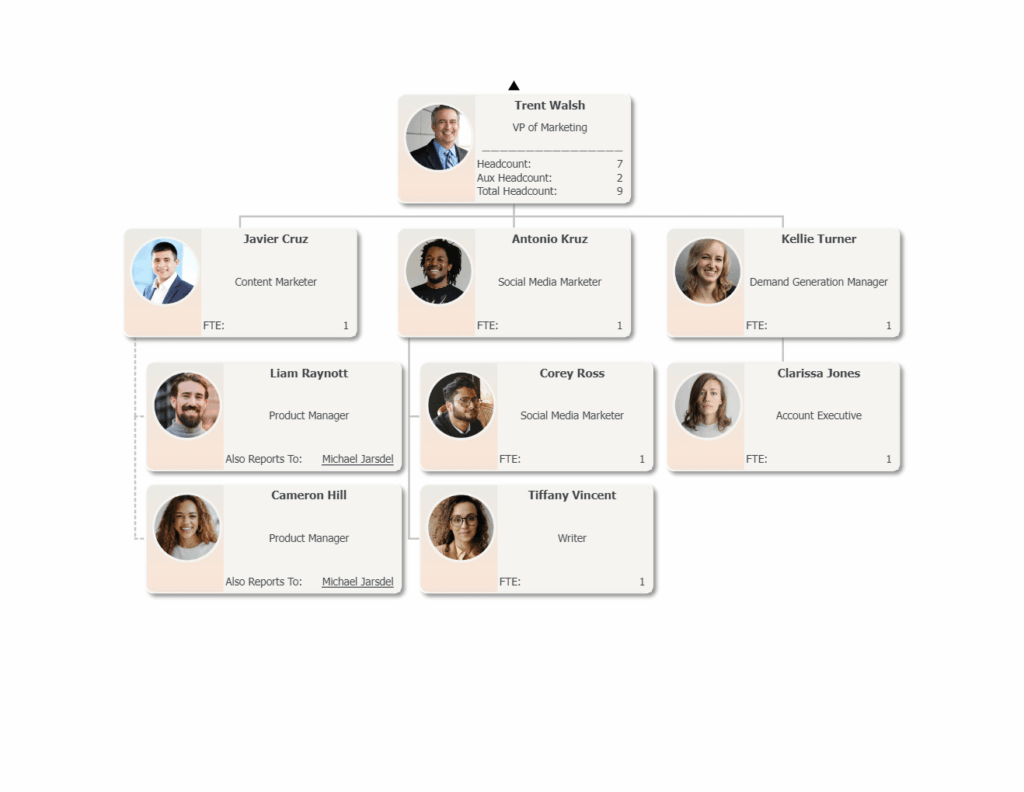
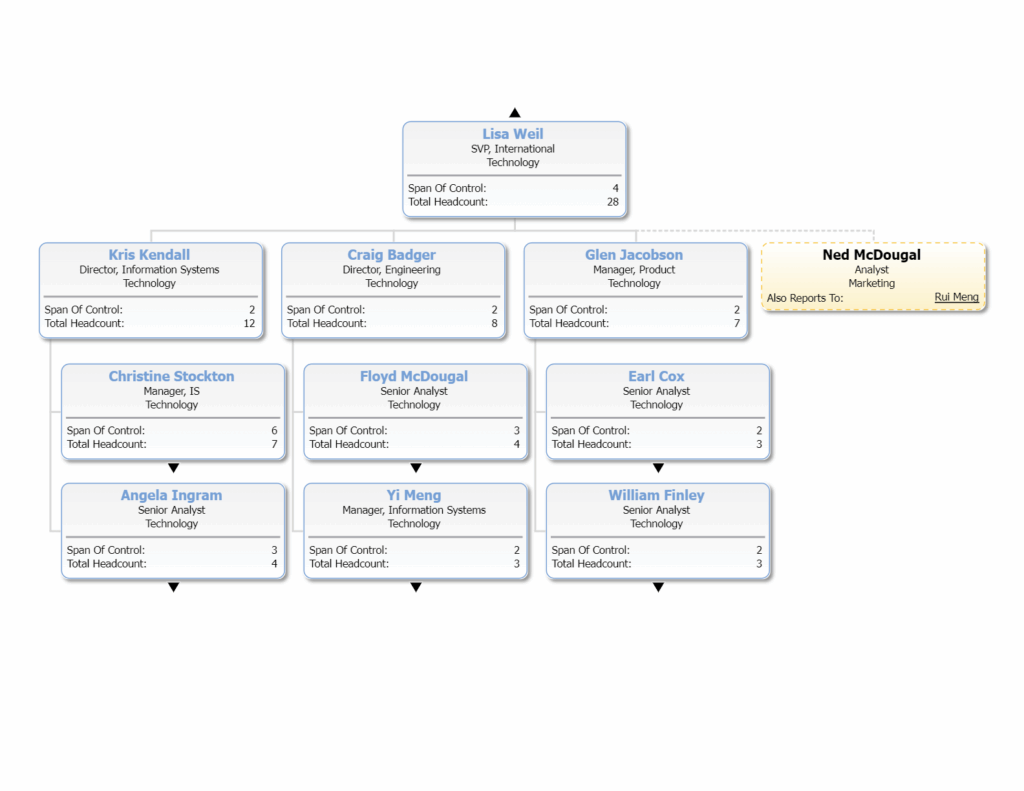
On organizational charts, dotted line reporting relationships are represented by actual dotted lines. These connections depict who is connected to each team in a cross-functional capacity. In an org chart, employees will have a solid line linking them to their primary manager and dotted lines connecting them to any additional managers.
Here’s a quick chart to break this down further:
| Org Chart Indicator | What It Represents | Common Misinterpretation |
| Solid line | Primary reporting relationship | Total ownership of all work |
| Dotted line | Secondary / contextual relationship | Equal authority |
| Multiple dotted lines | Shared services or project alignment | Matrix confusion |
| Missing dotted lines | Undocumented relationships | Shadow authority |
Why Static Org Charts Fall Short for Dotted Lines
Static org charts, typically in the form of a spreadsheet or slide presentation, are common options for companies that are just getting off the ground. However, static tools cannot support organizations at scale, especially in dotted line structures. Using a spreadsheet or slide org chart for dotted line relationships instead of an automated tool can lead to the following issues:
- Lack of Visibility: When teams are isolated on slides or depicted in boxed formats, it’s difficult to capture every single reporting relationship. Dotted line reports may be left off the chart as a result, leading to missing information and an incomplete image of your organization.
- Change Frequency: Your org chart must be updated after every staffing change, no matter how small. Static org charts require manual updates, which can be time-consuming and leave room for human error.
Governance Gaps: Static org charts are typically saved on company drives or distributed via email. This lack of centralization leaves org charts vulnerable to unintentional edits, and HR leaders will risk sending incorrect, incomplete, or outdated org charts to their teams.
Ready to Fix Visibility Gaps in Your Dotted-Line Org Chart?
Book a demo to see how OrgChart dynamically maps dotted-line reporting relationships, giving your team full visibility into structure, ownership, and accountability.
Governance and Clarity at Scale
As organizations grow, their organizational charts must grow with them. Correctly representing dotted line relationships will become more complex, making proper governance essential.
Ownership, Decision Rights, and Escalation Paths
As dotted line relationships extend between more and more teams, HR leaders must ensure they’re being managed properly and all parties are aware of their responsibilities in this structure. HR must take the lead in owning dotted line relationships, ensuring managers are not overwhelmed with too many reports and employees are clear on who they go to for which projects. Should conflicts arise, HR should also establish escalation paths to elevate issues and ensure disagreements are appropriately mediated and resolved by independent parties.
The decision-making power of each manager must be clearly defined. This helps managers know when they may be overstepping, and empowers the employee with clear boundaries on which manager has the final say on which tasks. This multi-level governance is foundational to ensuring dotted line relationships remain functional and effective in your organization.
Visibility as an Org Design Input
In a dotted line org chart, total visibility is paramount. If employees do not have the full picture of their company, they cannot understand the intricacies of each department and gain clarity on their own reporting relationships. Once dotted line relationships have been properly established, they must be added to the organizational chart.
With this clarity, HR leaders can choose the organizational design that suits the company best, whether that’s a matrix structure, functional chart, or hierarchical flow. Additionally, defined dotted line relationships enable better workforce planning, as leaders can see the exact state of each manager’s span of control and how much support each team has on staff. With this knowledge, HR will be better able to forecast future staffing needs, simulate new structures, and develop strategies to fill skill, talent, and capacity gaps.
When to Reevaluate or Redesign Dotted Line Relationships
As with all organizational structures, dotted line relationships must be regularly reevaluated to ensure they remain functional and effective. Here are a few signs that your current dotted line reporting structure is no longer working:
- Persistent Conflict: Managers regularly run into disagreements over authority, decision-making, and employee workloads.
- Stalled Decisions: High-impact decisions run into delays and employees can’t get the approval they need for projects.
- Unclear Reviews: Employees receive conflicting or excessive feedback from all of their managers during performance evaluations, leaving them confused about where they have room to improve.
- Unclaimed Tasks: Team members aren’t sure who owns which tasks, leading to missed deadlines and rushed deliverables.
- Overlapping Responsibilities: Multiple employees or teams are working on the same project and accidentally execute double work due to a lack of accountability and task clarity.
- Inaccurate Roles: An employee’s role places them in one team, but the majority of their projects and daily tasks are housed in their secondary manager’s department.
Learn More About Reporting Lines and Organizational Structure
Dotted-line relationships work best when reporting lines, decision rights, and accountability are clearly defined and consistently visible. As organizations grow, that clarity becomes harder to maintain without a structure that reflects how work, authority, and cross-functional ownership actually operate.
Static org charts don’t have the capabilities necessary to visualize dynamic dotted line reporting structures at scale. It’s impossible to control what you can’t see. OrgChart’s workforce planning and organizational charting solution sets teams up for success, clearly visualizing a company’s structure and relationships at every level.
Take Control of Your Dotted-Line Reporting Structure
See how OrgChart helps you manage complex reporting relationships, improve visibility, and support better organizational design at scale.